
Choosing the wrong size is one of the most common reasons sticky bras fail. Gaping edges, slipping, weak lift, or discomfort usually trace back to incorrect sizing rather than adhesive quality.

In most cases, sizing down a sticky bra is not recommended; correct sizing should match breast base width and coverage needs rather than cup volume alone.
Sticky bras function very differently from traditional bras. Their performance depends on surface contact, pressure distribution, and structural design, all of which are directly affected by size selection. Understanding sizing logic requires looking at both wearing mechanics and how sticky bras are engineered in manufacturing.
How does sizing affect how a sticky bra works?
Sticky bras rely on contact, not compression.
Proper sizing ensures full adhesive contact with the skin, which is essential for stability, shaping, and comfort.

Unlike traditional bras that use bands and straps to redistribute weight, sticky bras depend entirely on adhesive surface contact. The adhesive must sit flat against the skin to function correctly.
When a sticky bra is sized down too much, the adhesive surface area decreases. This reduces overall holding power and concentrates stress along the edges. As a result, edge lifting, rolling, or detachment becomes more likely, especially during movement.
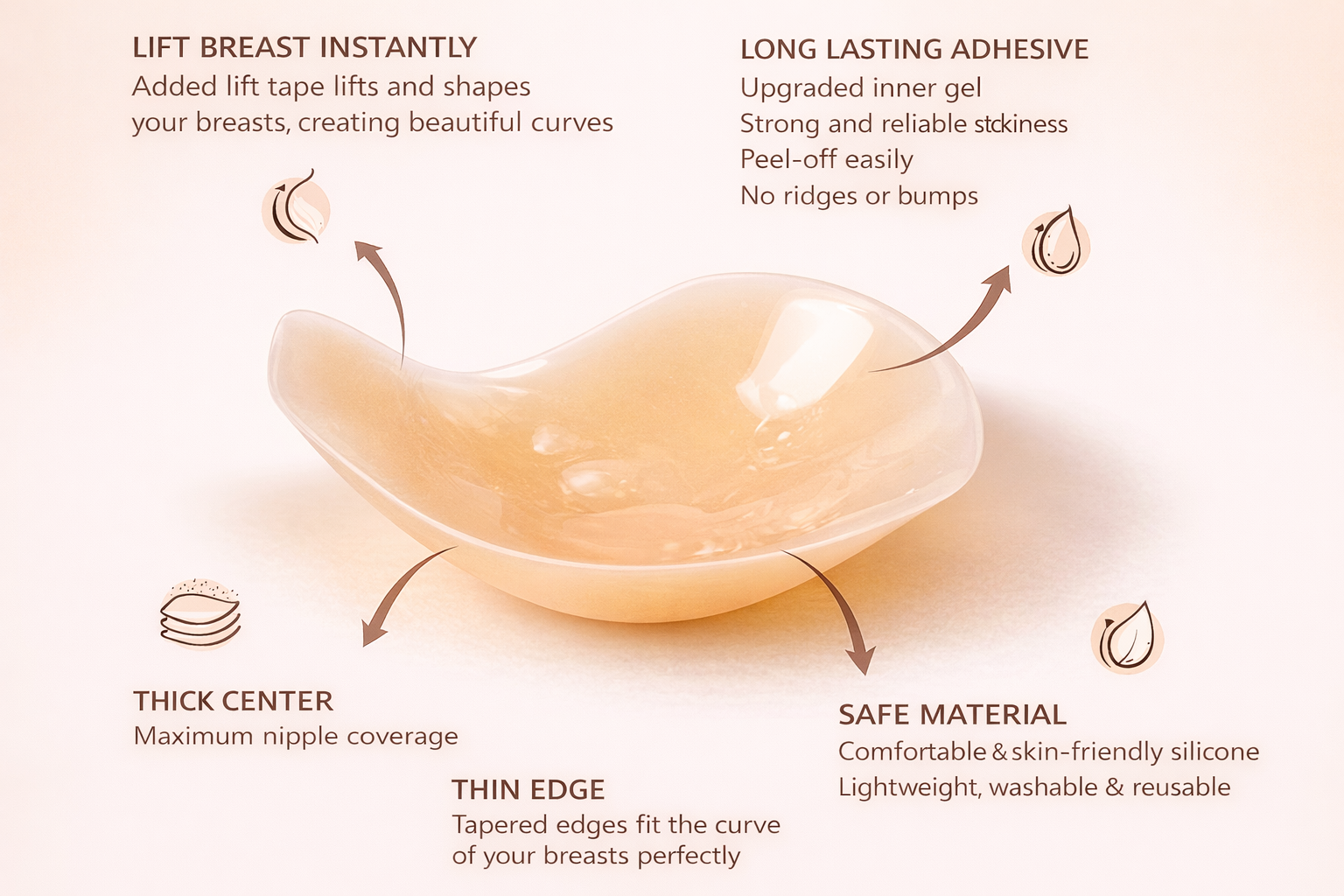
Manufacturers design sticky bras with specific coverage ratios. Cup width, height, and curvature are engineered to match natural breast contours. Proper sizing allows the silicone structure to distribute pressure evenly rather than forcing compression.
Factory wear tests consistently show that correct surface coverage provides better lift and longer adhesive life than aggressive sizing down.
Why do people think sizing down gives more lift?
Lift is often misunderstood.
Sizing down may feel tighter initially, but it does not create true lift and often reduces stability.

Many assume that a smaller sticky bra pulls breasts upward more effectively. In reality, sticky bras do not lift by pulling upward. They lift by guiding tissue inward and supporting it through molded structure.
When sized down, the cups may compress the breast instead of shaping it. This can flatten the appearance rather than enhance it. Compression also increases skin stress and discomfort.
In manufacturing, lift performance is engineered through mold geometry and thickness mapping, not reduced size. Thicker support zones are placed strategically to guide shape without excessive pressure.
Sizing down interferes with this design logic, preventing the silicone structure from working as intended.
When is sizing down sometimes acceptable?
There are limited exceptions.
Sizing down may work for shallow coverage styles or for individuals between two sizes, but only within controlled limits.
Some sticky bra designs are intentionally minimal, offering partial coverage rather than full cup support. In these cases, a slightly smaller size may be chosen to reduce visible edges under low-cut garments.
However, this approach depends heavily on breast shape, skin condition, and adhesive quality. Even then, sizing down should never compromise full adhesive contact.
Factories account for these scenarios by offering multiple cup shapes and coverage options rather than encouraging incorrect sizing. Different molds are developed for push-in, lift-focused, or coverage-focused designs.
Choosing the right style is more effective than sizing down indiscriminately.
How does incorrect sizing affect adhesive lifespan?
Size choice impacts durability.
Incorrect sizing accelerates adhesive wear and shortens product lifespan.
When a sticky bra is too small, adhesive layers experience higher localized stress. Edges lift first, collecting dust and oils that are difficult to remove during cleaning.
This uneven stress causes adhesive fatigue. Over time, stickiness becomes patchy, reducing reusability even if the adhesive formulation is high quality.
Manufacturers test adhesive durability assuming correct sizing and full contact. Wear-and-wash simulations show that properly sized bras maintain adhesion consistency far longer than undersized ones.
Sizing correctly protects not only comfort but also long-term performance.
How do factory design and molds influence sizing accuracy?
Sizing is engineered at the mold level.
Sticky bra sizes are defined by mold geometry, thickness distribution, and intended coverage, not arbitrary cup labels.
In production, each size corresponds to a dedicated mold. These molds define cup depth, width, curvature, and edge tapering. The relationship between these dimensions determines how the bra interacts with the body.
Factories with in-house design and R&D capabilities develop multiple prototypes for each size. Wear testing evaluates contact area, lift effect, edge behavior, and adhesive stress.
Sizing charts are based on this data, not guesswork. When sizing guidelines are followed, the product performs as designed.
Using a smaller size than intended bypasses this engineering and introduces unpredictable results.
What should be considered instead of sizing down?
Fit strategy matters more than size reduction.
Choosing the correct style, coverage level, and placement technique is more effective than sizing down.

If lift or cleavage is insufficient, the solution usually lies in style selection rather than size reduction. Front-closure designs, thicker center zones, or winged cups often provide better shaping.
Placement technique also affects results. Applying the cups from the lower outer area inward improves shaping without increasing pressure.
Manufacturers design multiple variants to address different needs. Selecting the right design preserves comfort, stability, and adhesive performance.
Sizing down should be a last resort, not a default choice.
Conclusion
Sizing down a sticky bra is generally not recommended. Sticky bras work best when sized to provide full adhesive contact, even pressure distribution, and proper structural support. Undersizing reduces stability, shortens adhesive lifespan, and often compromises shaping rather than improving it. Correct sizing, combined with the right style and engineered mold design, delivers better lift, comfort, and long-term performance than simply choosing a smaller size.
