
Bad silicone bra production creates the same problems again and again. Weak adhesion, thick edges, wrong cup shape, unstable quality, and skin irritation all start inside the factory.
Silicone bra manufacturing in a factory follows a full process from raw material selection, mold forming, adhesive treatment, trimming, inspection, and packing. Stable production depends on controlling shape, edge softness, adhesive performance, and batch consistency at every step.
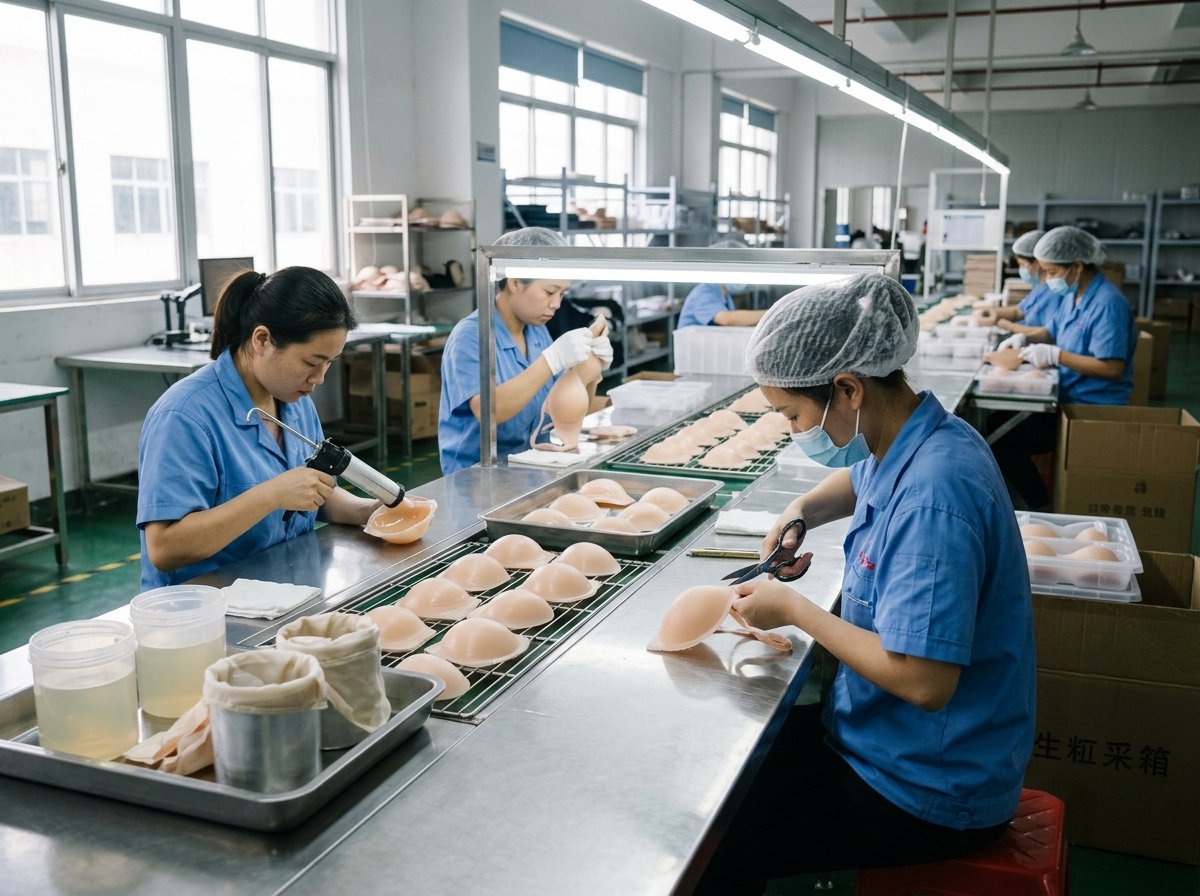
From the outside, a silicone bra looks simple. In real production, it is not simple at all. The final result depends on how the silicone is chosen, how the mold is built, how the cup shape is formed, how the adhesive layer is controlled, and how each pair is inspected before packing. Many public complaints about silicone bras are not caused by one single mistake. They usually come from weak process control across several steps. That is why a real factory with in-house design, R&D, and production coordination can make a big difference for brand owners, distributors, sourcing teams, and product developers.
Why Does the Silicone Bra Manufacturing Process Matter So Much?
Many buyers focus on sample appearance first. That is understandable. But a nice-looking sample does not guarantee stable bulk production. A silicone bra can look smooth on the table and still fail after a few hours of wear.
The manufacturing process matters because most market complaints come from production details such as poor adhesive control, thick cup edges, inaccurate sizing, weak molding, and unstable pair matching.
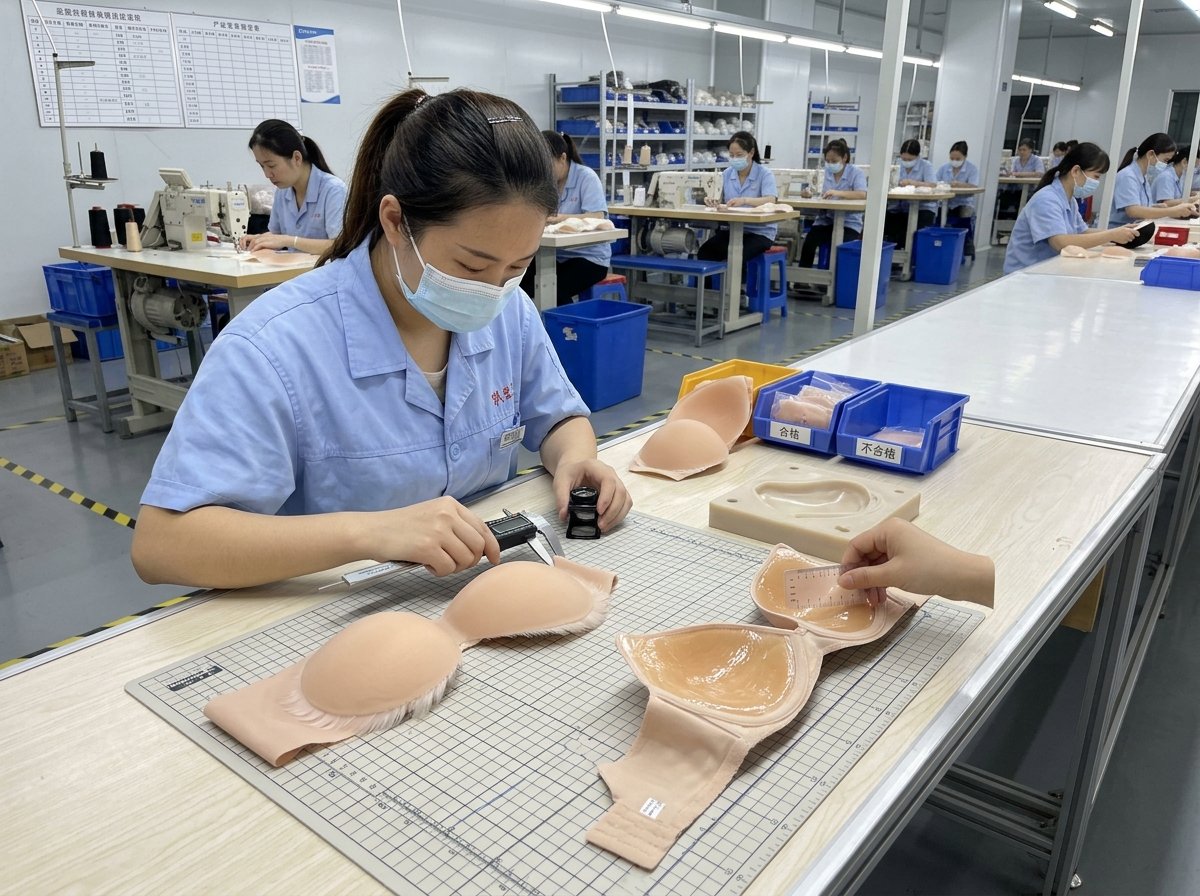
Based on common market feedback, the biggest complaints are very clear. Some bras do not stick well. Some fall off after sweat or movement. Some feel painful when removed. Some look bulky under clothing. Some work once and then lose adhesion. Some do not match the size chart. Some are sold as support products, but only provide basic coverage.
These problems usually start in the factory, not at the packing table.
Common quality issues linked to production
| Market complaint | Likely factory-side cause | What should be controlled |
|---|---|---|
| Falls off easily | Weak adhesive or poor cup fit | Adhesive formula, curvature, edge design |
| Edge shows under clothes | Thick trimming or hard transition | Feather edge forming, trimming precision |
| Feels painful to remove | Peel force too high | Adhesive balance and skin-friendly design |
| Cup looks fake or bulky | Mold too thick or shape too stiff | Mold depth, thickness control, silhouette design |
| Poor reuse performance | Adhesive contamination or low recovery | Protective film, cleaning recovery, storage control |
| Left and right not matching | Weak pairing QC | Size sorting and pair inspection |
A factory that understands these repeated pain points can build the product around real-use performance. That is much more useful than simply copying a market style.
Step-by-Step Silicone Bra Production Flow from Raw Material to Packing?
The production flow of a silicone bra is not only about molding silicone into a cup. It is a chain of material, process, and inspection steps.
A standard silicone bra production flow includes raw material preparation, mold setup, silicone forming, shaping, adhesive application, curing, trimming, pair matching, quality inspection, and final packing.
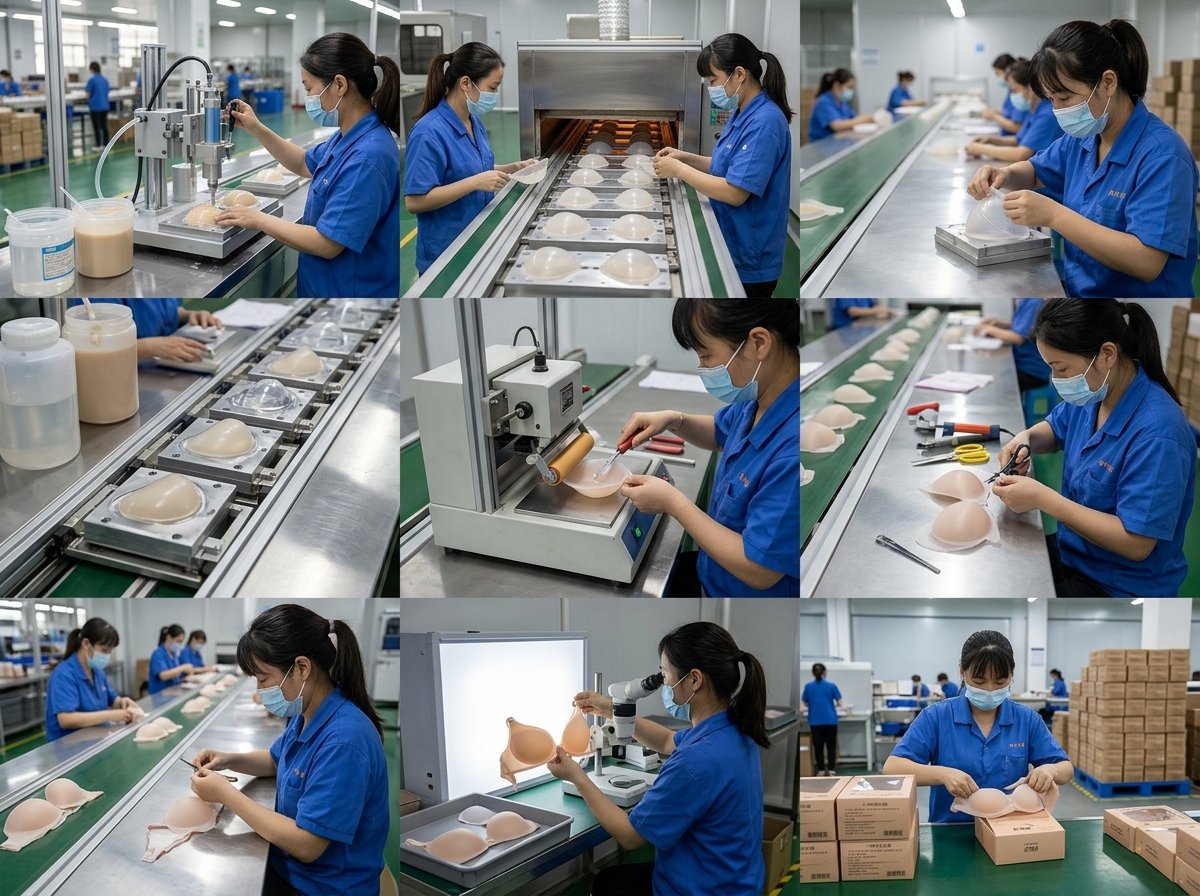
1. Raw material preparation
Production starts with silicone raw material, film layers, release liners, adhesive materials, front clasps or connectors, and packing materials. This stage is more important than it looks. If the silicone softness is wrong, the cup may feel too hard. If the adhesive quality is unstable, the product may fail in wear tests even if the cup shape looks fine.
For serious projects, raw material checks should include softness, color consistency, odor, surface cleanliness, and compatibility with the target adhesive system.
2. Mold setup
After material preparation, the factory sets the mold according to the approved cup shape, size, and thickness. Mold quality decides a lot of the final product performance. A poor mold creates poor edge flow, bad symmetry, and unnatural cup depth.
This stage is especially important when the product needs different versions, such as natural coverage, push-up effect, fuller bust fit, or ultra-thin edges.
3. Silicone forming
The silicone is placed or injected into the mold and then formed under controlled conditions. Heat, pressure, and forming time all affect how stable the shape will be. If this step is not controlled well, the product may show dimples, wrinkles, uneven thickness, or hard transition zones.
4. Curing and cooling
After forming, the silicone must cure fully and cool in a stable way. Rushing this part can damage shape memory. Uneven cooling can also affect smoothness and edge consistency.
5. Adhesive lamination or coating
For adhesive silicone bras, the glue layer or adhesive surface is added after the main cup structure is ready. This step must balance holding power and removal comfort. Many products fail here. Some are too weak and fall off. Some are too aggressive and hurt the skin.
6. Trimming and edge finishing
After adhesive work, the cup edge is trimmed and refined. This is where invisible appearance is built. Thick or rough trimming creates obvious outlines under clothing. A soft feather edge is much better for real wear.
7. Pairing, inspection, and packing
The left and right cups must be matched correctly by size, shape, color, and finish. After that, protective films, inserts, instructions, and packing materials are added. If this stage is weak, even a good product can still arrive with mismatched cups, wrong labels, or damaged surfaces.
What Raw Materials Are Commonly Used in Silicone Bra Manufacturing?
Raw material choice affects comfort, durability, adhesion, and customer trust. Many product complaints start with the wrong material combination.
The most common materials used in silicone bra manufacturing are body-contact silicone, adhesive layers, protective release films, front closure parts, and retail packaging materials. Each one affects final performance and user experience.
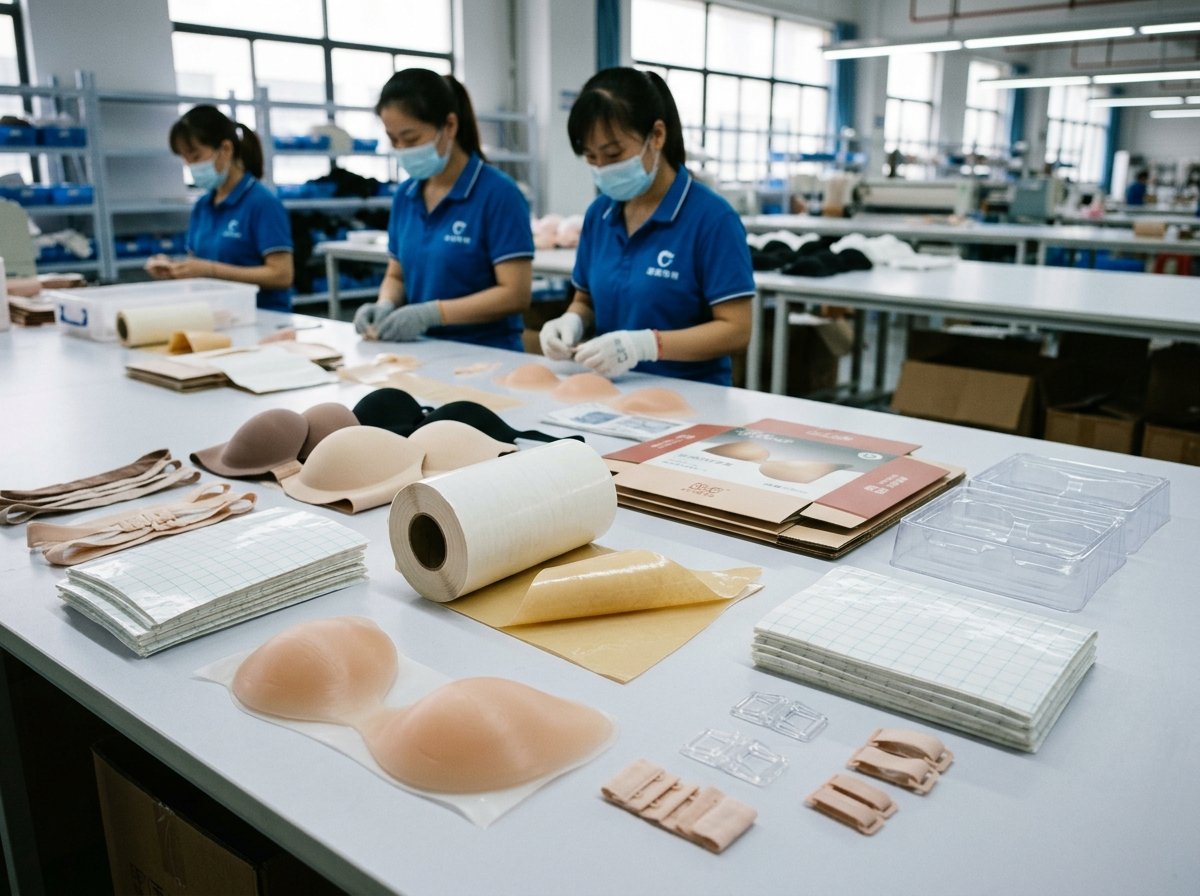
Factories usually work with different silicone softness levels depending on the product target. A softer structure may feel better on the skin, but it still needs enough body to hold shape. A thicker cup may create more cleavage, but it can also reduce flexibility and make the edge easier to lift.
Main raw material groups
| Material group | Function | Risk if poorly selected |
|---|---|---|
| Silicone body | Main cup structure | Hard feel, heavy weight, poor fit |
| Adhesive layer | Skin attachment | Falls off, irritates skin, poor reuse |
| Release film | Protects adhesive before use | Adhesive contamination or damage |
| Closure accessory | Front connection or lift effect | Weak shaping or broken connection |
| Color coating or tint | Nude shade matching | Uneven tone or poor appearance |
| Packaging materials | Protection and branding | Deformation, dust contamination, poor presentation |
Material matching is also important. A strong adhesive on the wrong cup structure does not solve the problem. It may simply make removal more painful. Good factories develop the cup body, adhesive behavior, and edge softness together, not as separate parts.
Key Machines and Processes Used in Silicone Bra Manufacturing?
Good output depends on the right equipment. Manual work still matters, but machine stability is what creates batch consistency.
Key machines in silicone bra manufacturing usually include silicone molding machines, heating and curing systems, trimming tools, adhesive lamination equipment, inspection stations, and packing lines.
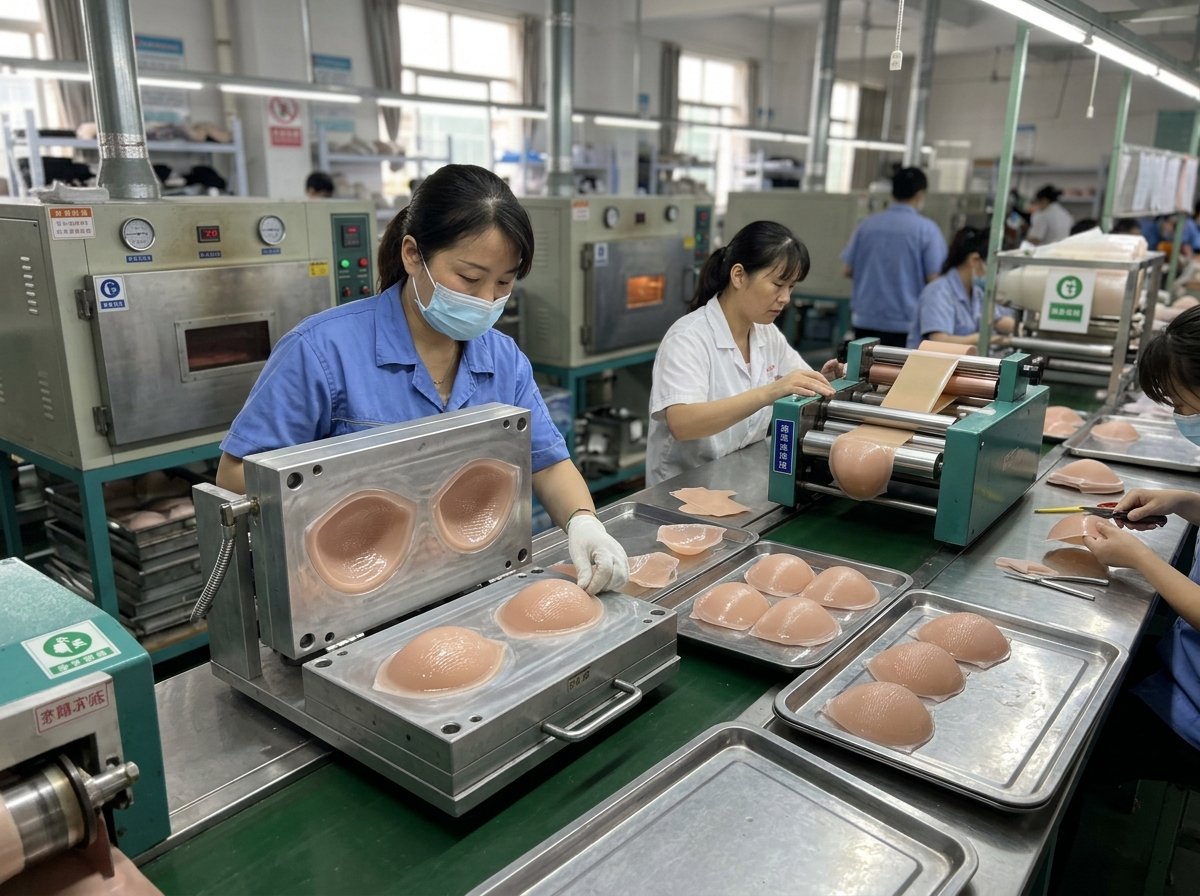
Different factories may use slightly different equipment setups, but the production logic is similar. The goal is always the same: shape accuracy, edge control, surface smoothness, adhesive consistency, and stable packing condition.
Common machines and their roles
| Machine or station | Main role in production |
|---|---|
| Mold forming machine | Creates cup shape and thickness profile |
| Heating/curing equipment | Stabilizes silicone structure |
| Adhesive laminating station | Applies or bonds the adhesive area |
| Edge trimming station | Refines cup outline and softness |
| Surface inspection station | Checks dimples, dents, dust, and appearance |
| Pairing and packing line | Matches cups and protects finished product |
Machine precision matters a lot in silicone bra production. For example, if mold pressure is not stable, cup thickness may change from batch to batch. If trimming is rough, edge visibility increases. If adhesive placement shifts slightly, the product may not fit the same way on both sides.
Factories with in-house design and R&D usually respond faster here because machine settings, mold changes, and trial adjustments can be handled by internal teams without too much delay.
How Is Adhesive Performance Controlled During Production?
Adhesive performance is one of the biggest make-or-break points in this category. Many public complaints repeat the same words: slips, peels, falls off, does not stay secure, hurts to remove, or stops working after a few uses.
Adhesive performance is controlled by formula choice, coating uniformity, curing stability, release film protection, cleanliness, and wear testing under heat, sweat, and movement conditions.
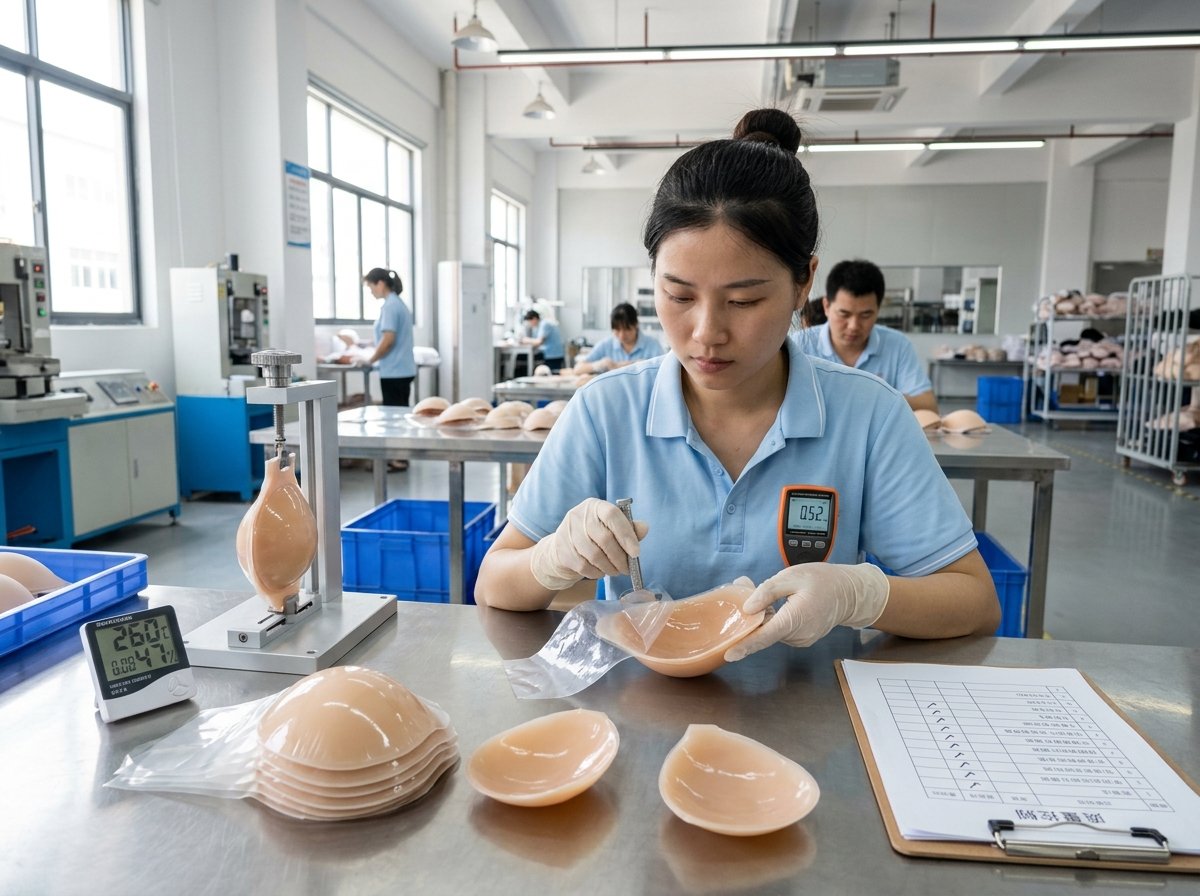
Some factories only ask whether the bra feels sticky in hand. That is not enough. A good adhesive silicone bra should be checked for initial grip, long-wear hold, sweat resistance, edge lifting risk, and removal comfort.
What factories should test for adhesive performance
| Test point | Why it matters |
|---|---|
| Initial tack | First impression and first wear security |
| Holding power | Prevents slipping during movement |
| Sweat resistance | Important for summer, weddings, dance, and long wear |
| Peel force | Prevents pain, redness, and skin damage |
| Reuse recovery | Supports repeat wear after cleaning |
| Edge lifting | Reduces visible failure during real use |
This is where many low-level products fail. Some brands overpromise “lift” and “support,” but the real adhesive system was never designed for active wear, fuller bust weight, or hot conditions. A real factory should develop clear product lines instead of forcing one structure to fit every use case.
Common Production Challenges and How Factories Solve Them in Silicone Bra Making?
Every factory faces production challenges. The important point is whether the factory can identify the root cause and fix it before it becomes a customer complaint.
Common production challenges in silicone bra making include uneven cup shape, visible edges, unstable adhesive, size mismatch, poor reuse performance, and packing errors. Good factories solve them through process control, mold adjustment, testing, and stricter QC standards.
Main production challenges and practical factory solutions
| Production challenge | What often causes it | Factory solution |
|---|---|---|
| Cup shape inconsistency | Unstable mold pressure or poor cooling | Tighten molding settings and cooling control |
| Edge too thick | Weak trimming or poor mold transition | Improve feather edge design and trimming accuracy |
| Adhesive too weak | Formula problem or contamination | Upgrade adhesive system and protect clean surfaces |
| Adhesive too aggressive | High peel force | Adjust formula and reduce painful removal risk |
| Poor fit for certain bust shapes | One-shape-for-all approach | Create different molds and better size grading |
| Mismatched left/right cups | Weak sorting and pairing | Add stricter final pair QC |
| Surface dents or creases | Mold defect or poor storage | Improve forming and anti-pressure packing |
| Short reuse life | Adhesive aging or poor film protection | Improve storage design and cleaning recovery |
These solutions sound basic, but many factories still do not control them well. That is why the same market complaints repeat across Reddit, YouTube, Instagram, Amazon, and review platforms. The category pain points are very stable. Products fall off when sweating. They do not provide real lift. They do not fit fuller bust users well. They can irritate skin. They may look bulky or fake. They may stop working after very few uses.
Factories that want long-term OEM/ODM business need to solve these category problems directly, not simply follow low-cost production habits.
How Does Quality Control Work Before Final Packing?
Quality control should not happen only at the end. It should run through the whole process. Still, final inspection is the last chance to catch visible errors before shipment.
Before final packing, silicone bras should be checked for symmetry, cup shape, edge smoothness, adhesive cleanliness, pair matching, accessory accuracy, and package correctness.
Final QC checklist
| Inspection item | What should be confirmed |
|---|---|
| Cup symmetry | Left and right match in depth, width, and shape |
| Surface finish | No dents, wrinkles, bubbles, or visible marks |
| Edge condition | Smooth, thin, and even |
| Adhesive area | Clean, centered, and protected |
| Closure/accessory | Correctly attached and functional |
| Packaging | Correct insert, label, shade, quantity, and artwork |
This stage is also where factory discipline becomes visible to buyers. Stable QC is one reason many brand owners prefer working directly with a real factory instead of only relying on trading coordination. A factory with internal design, R&D, production, and sales support can trace problems faster, revise samples more efficiently, and keep repeat orders more consistent. Experience working with known OEM/ODM projects also helps because brand-level requirements are usually stricter in fit, appearance, package accuracy, and lead time control.
Why Do Buyers Prefer Factories with In-House Development and OEM/ODM Experience?
Silicone bra production is not only about making pieces. It is about turning repeated market complaints into a better product.
Buyers usually prefer factories with in-house design, R&D, and OEM/ODM experience because those factories can improve shape, adhesive, packaging, and production stability in a more controlled and practical way.
For private label buyers, distributors, sourcing teams, and product managers, this matters a lot. A real factory can help with cup redesign, packaging structure, insert instructions, skin tone extension, and sample improvements without sending every issue through multiple outside channels. That saves time and reduces misunderstanding.
It also creates stronger long-term value. Once a stable base model is built, the product line can expand into more sizes, more shades, bridal versions, lighter daily styles, or stronger lift versions. That is much harder to do with a supplier that only offers basic copy production.
Conclusion
Silicone bra manufacturing is a full process, not a simple molding job. Better factories control materials, machines, adhesive, shape, and packing together to reduce complaints and improve product stability.
For custom development, private label production, or OEM/ODM cooperation, send an inquiry and leave contact details to discuss the right silicone bra project with a real factory team.
